
← Backup & Disaster RecoveryBackup and Disaster Recovery for Kubernetes
Backup and Disaster Recovery for Kubernetes
Protect Kubernetes environments from errors, ransomware, or entire region outages
Kubernetes is self-healing, but it won't save your data
Kubernetes replicates components and restarts anything that fails, making it excellent for handling hardware faults. However, that same replication faithfully copies errors—such as accidental deletions, faulty deployments, and ransomware—propagating them across all copies. Once that volume is lost, no manifest can bring it back. This is why you need two distinct layers of protection, operating on the same cluster with opposing goals:
Backups with scheduled copies to object storage, allowing you to restore data following errors, accidental deletions, or ransomware attacks.
Disaster Recovery with ready-to-go replication on a secondary cluster in another region, allowing you to get everything back up and running in minutes if an entire data center goes down.
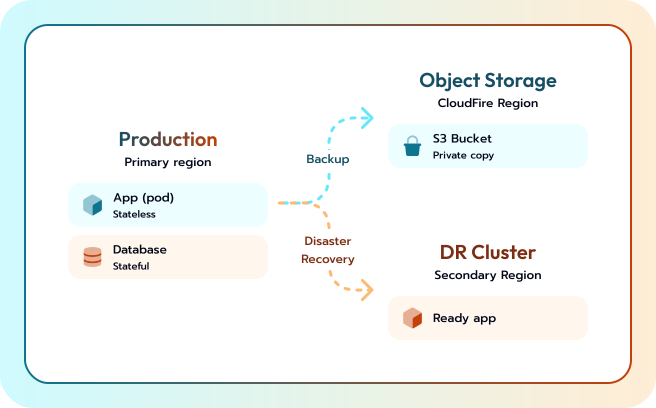
What tools can you use to do Backup and DR of Kubernetes?
Veeam Kasten K10
Kasten K10 by Veeam is a Kubernetes-native data protection platform that automatically discovers applications and treats them as a single unit, providing application-consistent backups.
Automatic detection of applications, dependencies, configurations, and data
Backup and restore applications and data across different clusters, regions, and clouds
Pre-qualified integrations with relational and NoSQL databases
End-to-end security: encryption, IAM, RBAC, OIDC
Multi-cluster management with global policies, also useful for migrations and dev/test environments
CloudCasa
CloudCasa is a backup and disaster recovery solution that integrates with Rancher via an add-on to protect applications across all your clusters.
Configuration and volume backups to object storage (S3 buckets, CloudFire region)
Disaster recovery to a secondary cluster in another region, ready to take over
Centralized multi-cluster management via Rancher
Orchestration of scheduled backups and DR replication

Resources


Openstack as a Service
Manage and deploy cloud resources in Italy autonomously with an as-a-Service model.

Openstack Cloud Native
Gain absolute control over your worker nodes on high-performance OpenStack instances.
FAQ
Doesn't Kubernetes already back itself up?
No. Kubernetes replicates components to ensure availability, but replication also propagates errors and ransomware. To recover deleted or corrupted data, you need a separate backup.
What is the difference between backup and disaster recovery?
A backup is a copy you restore from later after errors or attacks; disaster recovery is a ready-to-go copy at another site so you can get back up and running quickly when an entire cluster or data center goes down.
Kasten K10 or CloudCasa: which is better?
It depends on the scenario: CloudCasa is ideal with Rancher and for centralized DR to a second region, while Kasten K10 is best for application-consistent backups with native database integrations. A CloudFire expert can help you choose.
Where do backups go?
On object storage in CloudFire's Italian regions; disaster recovery copies go to a second cluster in another region.
Are backups ransomware-proof?
Yes. With immutable copies on object storage with Object Lock: once written, they cannot be modified or deleted for the entire retention period.